
The Mars Effect
Article by Francis [First published in 2014]

One most notable catalogue of research, and the one that was instrumental in bringing forth the “Objections to Astrology…” reaction, discussed in Science and Astrology, is Michel and Francoise Gauquelin’s huge (to say the least) research work[1] which gave ample evidence for there being a bit more than something to astrology.
Popularly known as “The Mars Effect,” the Gauquelin’s tested Mars (astrologically associated with physical energy, aggression, drive and passion), in the birth-charts of sports champions; for the planet’s association with eminent athletes.
I have published numerous works regarding my discovery of a series of highly significant statistical correlations between planetary positions and the birth times of eminently successful people. One of the strongest correlations I have observed is that sports champions tend to be born when the planet Mars is either rising or culminating in the sky much more often than it does for ordinary people.
Michel Gauquelin, statistician and psychologist [2]
Likewise, and perhaps less well known, they also tested the position of the Moon (for writers), Venus (artists), Jupiter (actors) and Saturn (scientists) in birth data of “eminently successful people” totalling over one hundred and forty-five thousand bits of birth data. This was a colossal amount of (group) research that thus far has never been equalled.
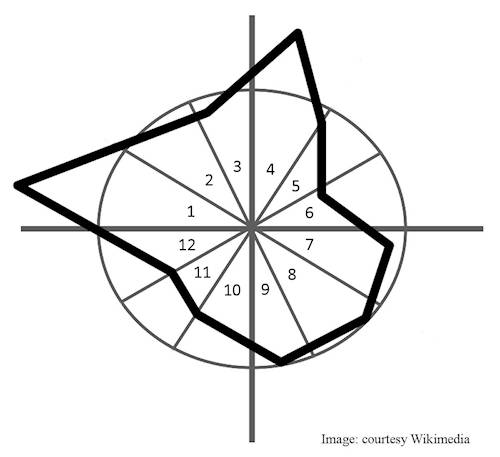 A Gauquelin diagram that illustrates the incidence of Mars according to the birth times of sports champions. Note the peaks just above the horizon on the east (left side) and at the south (top) to the right of the culminating point. Three smaller peaks can also be seen just below the horizon on the right (west), running around to the (north) nadir point. These peaks align close enough with the Angles used in astrology to be significant.
What they did was to plot the point of the planet under review (from the person’s birth time) to find its occurrence in one of twelve segments – running clockwise from the rising (east) point.
In each case the greatest density of points was found to occur around the rising or culminating positions on the graph – or segments one and four. The tests were repeated a number of times. In astrology these rising and culminating points, of course, also form the Angles of the birth-chart, and are viewed as very important and sensitive areas (notably the east Ascendant and south Midheaven) in interpretation.
So, with champion athletes, in one test, they plotted 2089 dots onto a graph representing their Mars positions. With famous actors 1409 dots were plotted onto a Jupiter graph, and likewise with eminent scientists 3647 points were plotted onto a Saturn graph.
They found the results in each case to be significant with high densities of dots congregating around the Ascendant and Midheaven cardinal points. The same pattern kept emerging. Running the same tests with random control samples arrived at chance patterns only.
It implied something was going on that also had a direct association with astrology, although not entirely following expectation. Astrologically speaking, finding an increase in the density of dots around the Angles (Ascendant and Midheaven) is very significant, but having the main peaks occurring in, what would be, the 12th and 9th houses of the birth-chart (instead of the 1st and 10th houses) was unexpected, and suggests the need for a possible change in astrological thinking.[3]
Too big to ignore
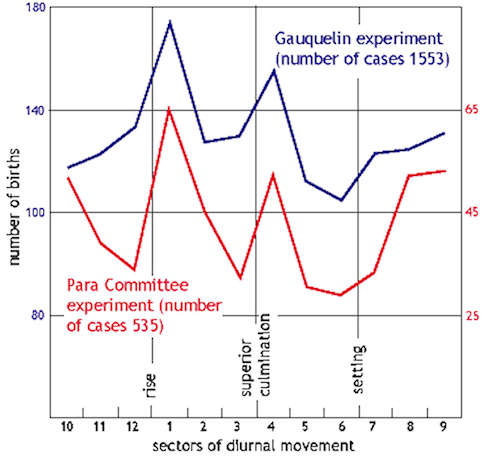
This research was big and had big implications; and it was too big and thorough to be just ignored by the rest of the scientific community. What happened next, not immediately but over years, was that three committees of scientists, the Belgian, French and American sought to repeat the Gauquelin’s findings. The Belgian group (Comité Para) were the first to rerun the Mars study, using Belgian athletes. They got the same pattern – see illustration.[4]
The French Committee for the Study of Paranormal Phenomenon (CFEPP) ran a study[5] on the Mars Effect with over 1000 Sports Champions. It reported in 1996 that its experiment showed no effect and concluded that the effect was attributable to bias in Gauquelin’s data selection.
 Likewise the American (CSICOP) committee arrived at a similar negative conclusion. There was a lot of toing and froing with accusations flying hither and dither. Let me suggest that every effort was made to rubbish the Gauquelin’s findings – before the “Objections to Astrology…” statement by 186 scientists, and after it.
The Gauquelin’s came in for a lot of flak from various members of the scientific community throughout the years but continued to defend their position that their research and findings were sound.[6] Michel Gauquelin died in 1991 – defending his research to the last.
Claims of foul play
But, so anyhow, was that it; was it another piece of research, and with it astrology biting the dust, with the words, “No evidence for it!”? Well maybe, maybe not.
There have been claims of foul play against the methodology used in the reruns of this particularly research. A book, The Tenacious Mars Effect by Suitbert Ertel and Kenneth Irving[7] highlights:
… the often dubious methods by which hostile sceptics have sought to discredit the Gauquelin’s uncomfortable findings and shows that, in fact, much of the evidence is even stronger than previously claimed.
Also, in January 2011, the Journal of Scientific Exploration carried an article that claimed:
The results of a research study [Mars Effect] that sceptics have used for more than two decades to debunk and deride astrology, “violated the demands of fairness and common norms of statistical analysis.”[8]
So I’d suggest this story isn’t over yet, by a long chalk…
References
[1] Gauquelin, M. (1976) Cosmic Influences. Future Publications Ltd.
[2] Gauquelin, M. (1988). Is there really a Mars effect? Above & Below: Journal of Astrological Studies, 11(Fall) pp. 4-7.
[3] The research was also based around testing single planets, which frankly would not be expected to produce such great results from an astrological viewpoint. As discussed elsewhere in the series, notably in Part 3, if the astrological system is anything it is holistic and founded on relationships. Those relationships are a better bet for research.
[4] The grid illustration is taken from The Mars Effect and Sports Champions: Comparison of Gauquelin and Comité Para Results. Sources: M. Gauquelin, Les hommes et les Astres (1960); and in Journal of Interdisciplinary Cycle Research 3 (1972); and Comité Para in Nouvelles Brèves 43 (1976)
[5] Benski, et al. (1993) The Mars Effect: A French Test of Over 1,000 Sports Champions. Prometheus Books.
[6] For much more on this story check out, Sceptics and the ‘Mars Effect’: A chronology of Events and Publications (compiled by Jim Lippard) on http://pldocs.org/docs/index-100912.html [Accessed 04/10/2014]. Also the Mars Effect on Wikipedia – http://en.wikipedia.org/wiki/Mars_effect [Accessed 04/10/2014].
[7] Ertel, S. & Irving, K. (1996) The Tenacious Mars Effect. Urania Trust.
[8] Astrology News Service http://astrologynewsservice.com/news/famous-test-of-astrology-is-seriously-flawed/ [Accessed 04/10/2014].
You might also like:
Article: The Church and Astrology
Article: The Backstory to Astrology Part 1
Learn to Read Your Birth-chart in 5 Steps
Article: Science and Astrology